

Oct 8, 2026
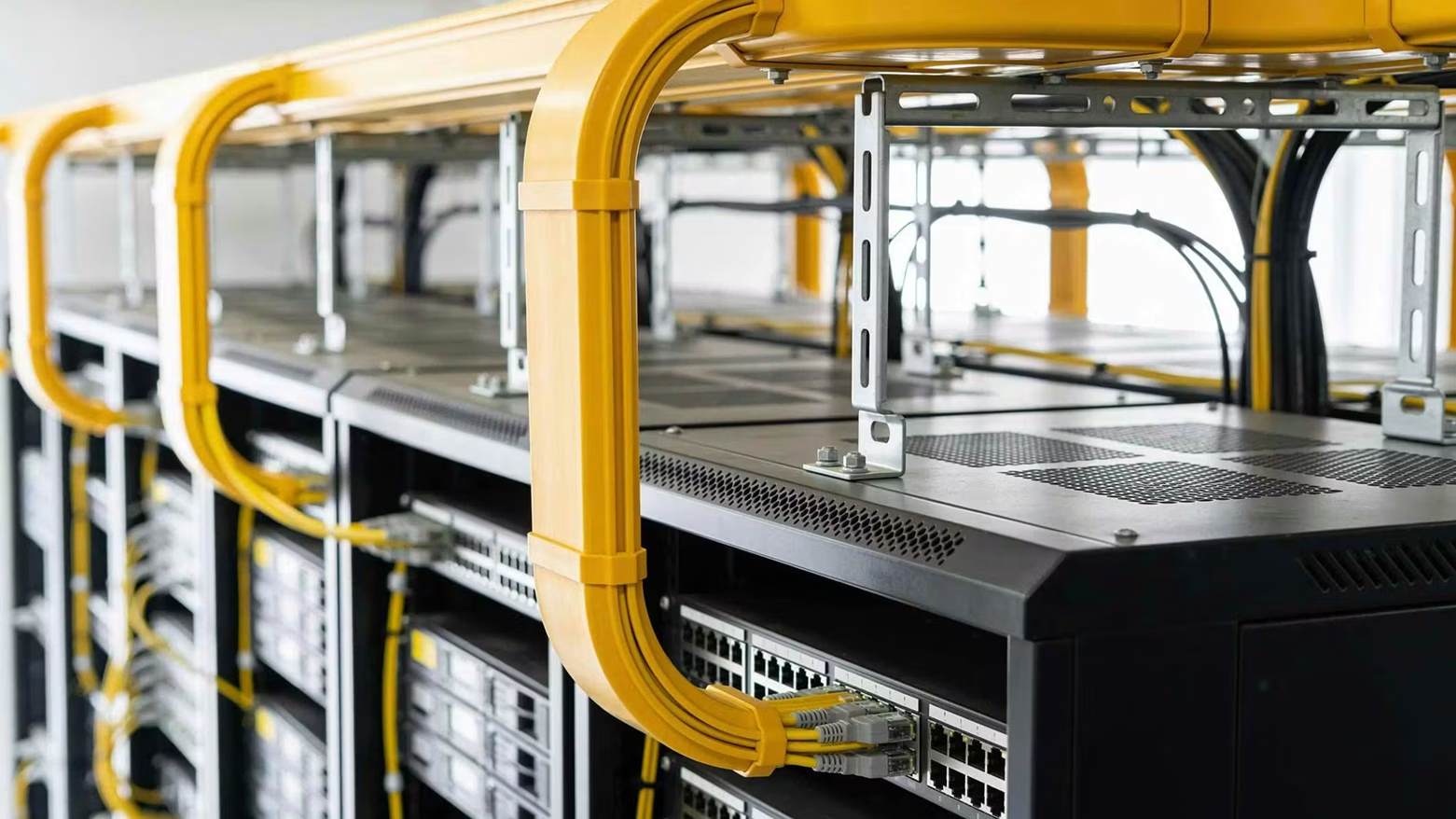
In a new article for Electronic Design, "Wanted: A New Efficiency Metric for AI Data Centers," Hans Hasselby-Andersen, CEO of Lotus Microsystems, explains why power usage effectiveness (PUE), the widely used efficiency metric for data centers, no longer gives the full picture in the AI era.
PUE compares a facility's total energy consumption with the energy that reaches its IT equipment. It captures facility-level overhead such as cooling, lighting, and power distribution. But PUE was designed for an era when server power draw was relatively modest and uniform, and its visibility effectively stops at the IT-equipment boundary. It doesn't show how efficiently power is converted and delivered once it enters the server.
Before power reaches an AI processor, it passes through several conversion stages:
Each stage has its own efficiency, and some power is lost as heat instead of being delivered to compute. Because PUE treats the IT equipment as a black box, it doesn't reveal these server-internal power delivery losses. As a result, a data center can report an excellent PUE while a meaningful share of its power is still lost within the server.
Five years ago, a typical rack drew roughly 5–8 kW. Today's AI facilities are designed for 15–50 kW per rack, and GPU-dense configurations exceed 100 kW. AI accelerators also demand far more current than the CPU-based racks PUE was developed around, with more aggressive and less predictable load transients. This means the power electronics must respond faster and maintain tighter tolerances.
At these power levels, conversion losses are no longer rounding errors but real, measurable waste. They mean higher electricity costs and more heat to remove.
PUE remains a useful metric, but on its own it shows only part of the cost and emissions picture. Energy lost inside the server still shows up on the power bill, still has to be cooled, and still carries an emissions footprint, yet PUE does not separately capture these losses.
The article calls for the industry to start treating server-internal power delivery as something to be measured and compared. That could mean pairing PUE with a conversion-stage efficiency measure or asking vendors to report power delivery efficiency the way they already report other performance specifications.
Operators don't need to wait for an industry standard. They can ask vendors how power delivery efficiency is measured stage by stage, especially at the point of load, where high current density makes efficient power delivery increasingly challenging.
Read the full article on ElectronicDesign.com.


