Customized LTG

No two thermal challenges are the same. Customized Lotus Thermal Guides are engineered to meet your application’s thermal and mechanical requirements.

Customized to your design

Every thermal challenge is different. That’s why Lotus Microsystems offers customized Lotus Thermal Guides designed around your application rather than forcing your design to fit a standard package.

Customized LTGs retain all the advantages of our patented silicon-based thermal jumper technology, including high thermal conductivity and electrical isolation, while allowing engineers to optimize the device for their specific thermal path.

Contact us
X-Y Dimensions
Tailored X-Y dimensions to match your package size, PCB layout, and thermal interface requirements.
Component Height
Optimized component height, customizable from 100 µm to 3 mm, to accommodate different mechanical stack-ups while maintaining efficient thermal contact.
Component Footprint
Custom footprint and contact geometry designed to match your component package for seamless integration into your PCB assembly.
Heat Transfer Direction
Available with lateral, vertical, or combined lateral-vertical heat transfer configurations to match your application’s thermal requirements.

Conventional vs. Vertical Thermal Management

Conventional Thermal Stack

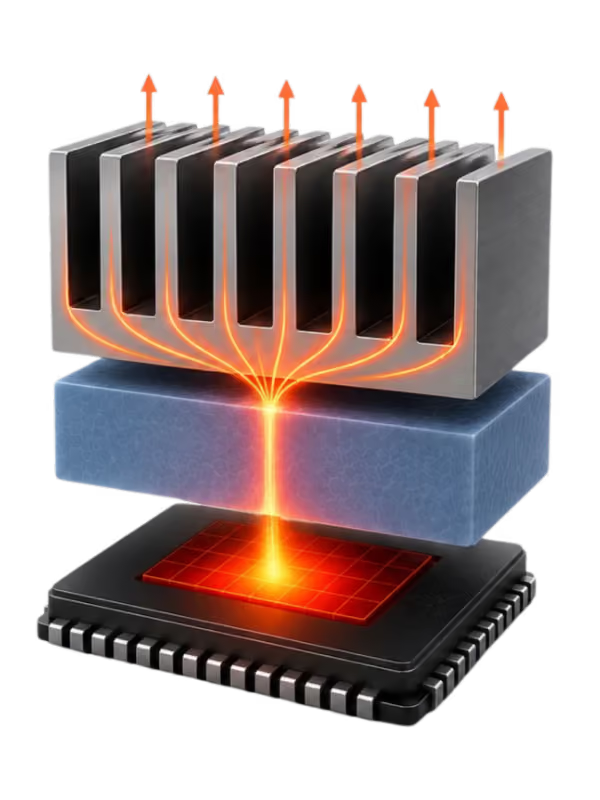
Traditional semiconductor cooling relies on thermal interface materials (TIMs) to transfer heat from the IC package to the heatsink. Because electrically insulating TIMs have relatively low thermal conductivity, they often become the main thermal bottleneck.

The difference in thermal expansion between the semiconductor package and the heatsink also requires a thicker TIM layer to reduce mechanical stress and warpage, which further increases thermal resistance.

As heat spreads laterally through the TIM before reaching the heatsink, cooling becomes less efficient and hotspot removal is limited.
Thermal Management with Vertical LTG

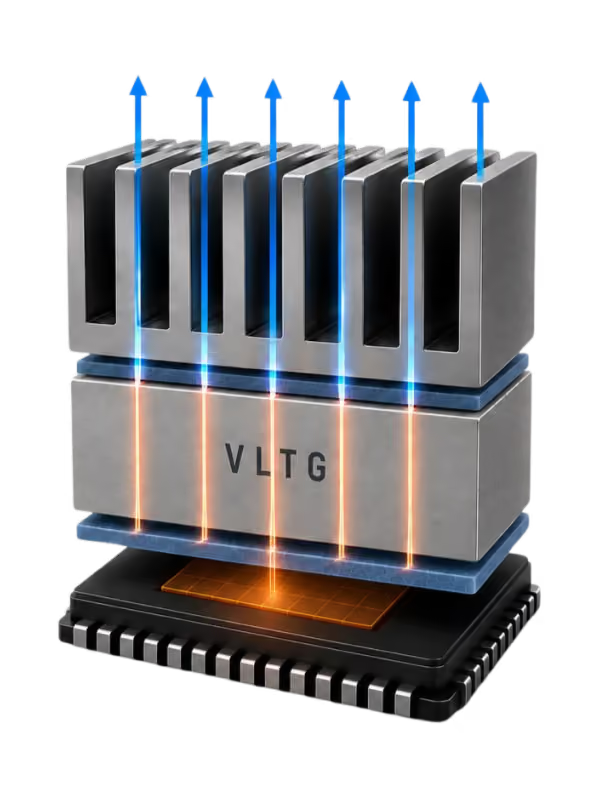
Vertical LTG enables a direct thermal path from the IC package to the heatsink. Its electrically isolated silicon structure allows the use of a thin, highly thermally conductive TIM.

By removing the primary thermal bottleneck, Vertical LTG significantly lowers thermal resistance and transfers heat directly to the heatsink for more efficient cooling and improved hotspot removal.

Optical Communication

Vertical LTG Integration in 800G+ Optical Transceiver Modules

As optical transceivers evolve to 800G, 1.6T, and beyond, increasing power densities create significant thermal management challenges. High-power components such as DSPs, retimers, and laser driver ICs generate localized hotspots that must be efficiently cooled to maintain performance and reliability.

Vertical Lotus Thermal Guides (LTGs) create a dedicated thermal pathway that transfers heat directly from these hotspots to the module lid while maintaining complete electrical isolation. By bypassing the PCB as the primary heat-spreading path, Vertical LTGs enable more efficient cooling where conventional thermal solutions reach their limits.

Read Technical Solution Brief
Lotus Microsystems Thermal Guide
Cooling Localized Hotspots
As optical transceivers evolve to 800G, 1.6T, and beyond, increasing power densities create localized hotspots in DSPs, retimers, laser drivers, and other high-power components.

Vertical LTGs create a dedicated thermal path that transfers heat directly from these devices to the module lid and host heatsink.
Maintaining Electrical Isolation
High-speed optical modules require complete electrical isolation between active components and the module housing.

Vertical LTGs combine high thermal conductivity with electrical isolation, enabling efficient heat transfer without compromising electrical performance.
Designed for Compact Module Architectures
Space inside optical transceivers is extremely limited. Customized LTGs are manufactured in application-specific footprints and heights, allowing seamless integration into low-profile module designs without changing the mechanical architecture.
Supporting Higher Data Rates
As bandwidth continues to increase, thermal management becomes a limiting factor for module performance and reliability.

Vertical LTGs improve heat transfer from critical components, helping optical modules meet the thermal demands of next-generation networks.

FPGA

Vertical LTG Integration in FPGA Designs

As FPGA performance continues to increase, higher power densities create localized hotspots that can limit performance, reliability, and system lifetime. Efficient thermal management is essential, particularly in applications where traditional PCB heat spreading is insufficient.

Vertical Lotus Thermal Guides (LTGs) provide a dedicated, high-conductivity thermal path that transfers heat directly from the FPGA package to the heatsink while maintaining complete electrical isolation.

Altera Solution Partner

Lotus Microsystems has been selected as an Altera Solution Partner, providing advanced thermal management solutions for high-power hotspots in FPGA applications.

Visit Altera Page
Lotus Microsystems Thermal Guide
Efficient Heat Removal
Modern FPGAs dissipate significant amounts of heat that must be transferred efficiently to the heatsink. Vertical LTGs create a dedicated thermal path that reduces thermal resistance between the package and the cooling solution.
High-Conductivity TIMs
By providing electrical isolation within the thermal stack, Vertical LTGs enable the use of highly thermally conductive, electrically conductive TIMs. This reduces the overall thermal resistance and improves heat transfer efficiency.
Customized Integration
Every FPGA platform has unique package dimensions and cooling requirements. Customized LTGs are designed to match the required footprint, height, and heat transfer direction for seamless integration into the existing system.
Sustained Performance
Lower junction temperatures help maintain stable operation during continuous high-power workloads, supporting reliable performance in AI acceleration, networking, industrial computing, and embedded systems.

How We Work

From concept to production, we work with you to develop a customized LTG tailored to your thermal, electrical, and mechanical requirements.

Contact us
Lotus Microsystems three technology pillars
1
Understand Your Thermal Challenge

We review your thermal, electrical, and mechanical requirements.

2
Design Your Customized LTG

Our engineers optimize the LTG geometry, heat transfer direction, and integration with your thermal stack to maximize heat transfer and overall thermal performance in your design.

3
Validate and Manufacture

We support prototype evaluation, design validation, and the transition to volume production.